
In Conversation with Eric N.Mack

Malchijah Judah Hoskins:
Why Arts and Letters, and why now?
Eric N. Mack:
Arts and Letters was a great opportunity with special significance to my life, both academically and personally, as an artist and former art student. I had only visited once before to see a juried exhibition. Being part of the shift toward these in-depth solo exhibitions for artists is meaningful. In this moment, it feels significant to the community as a more publicly accessible place from which many conversations can emerge, held within a constellation of artists.
MJH:
There's a lot of conversation between your work and Diane Simpson’s. In all of the shows there are through lines, but especially in how you both deconstruct fashion and fabric.
ENM:
That was also a really interesting point that Jenny Jaskey was speaking of. I agree; Diane Simpson and I were both shown at the Whitney Biennial 2019, and there are other kinds of correlations that I think will continue to happen far past my exhibition.
MJH:
How did you come upon the title Fishers of Men, and does it impact how you want viewers to interact with your work?
ENM:
The title for me is not a literalism. I think about titles as opportunities for poetry. There are a lot of moments in thinking about how we go through the world experiencing texts and significant markers of language.
I was looking at some old drawings that I made from a rubbing of a menu page from a seafood restaurant called Fishers of Men on 125th, and it was directly across from the Studio Museum. I always liked the signage; it just felt like its own contained artwork. The relationship to the Bible, the meaning in the food, this transference—the fact that beauty and savior are wrapped up in this relationship to the fish.
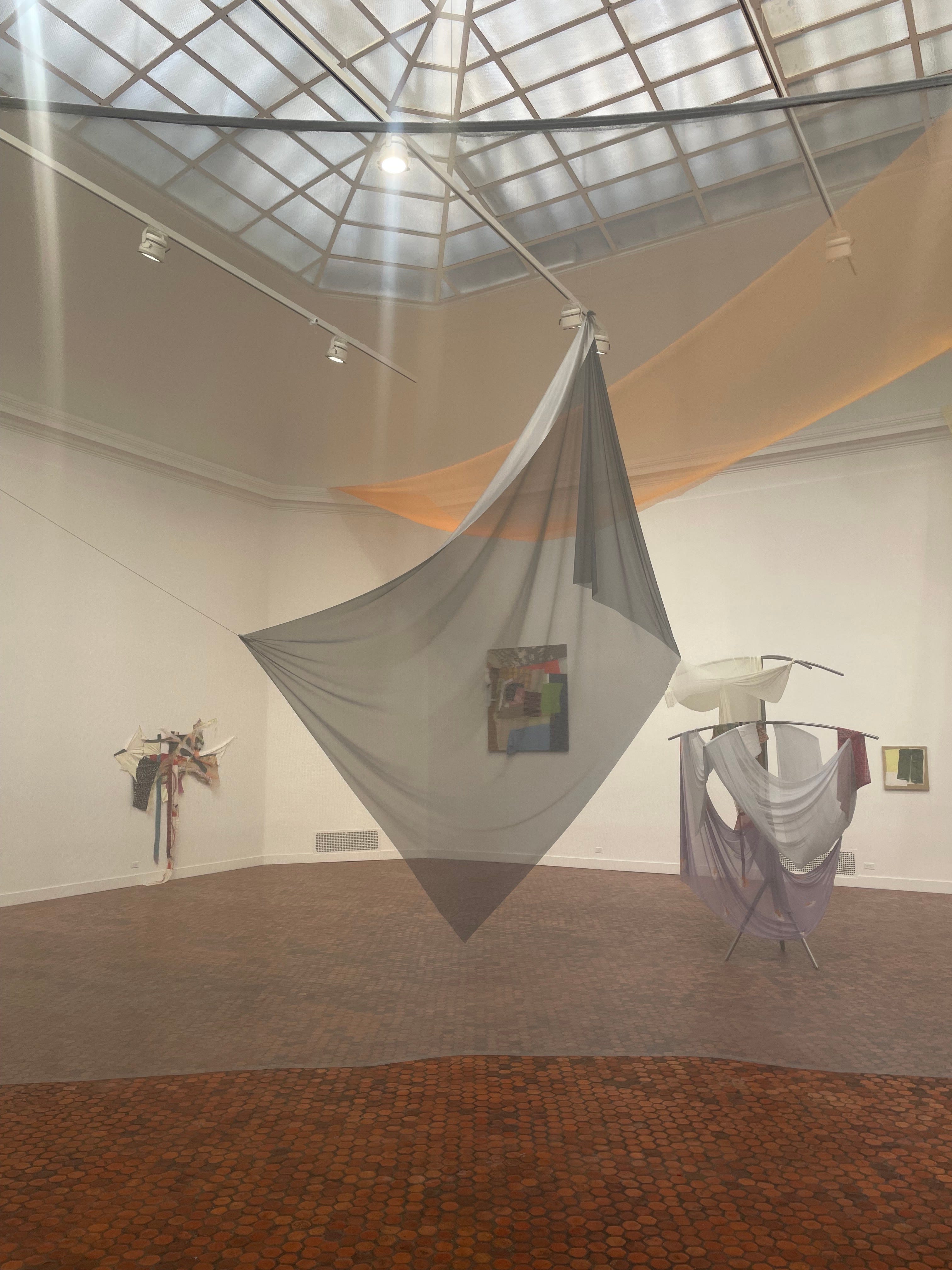
There's a ready-made aspect to it. The title had to come before the exhibition; there was a connecting point that early on was kind of disparate. Then later on I was like, "Oh, wow, it’s coming into its own meaning." There’s a connection between divinity and earth. There's this tether, there's this line—something that's either seeable or unseeable for a moment because of perception. Thinking about weightlessness, thinking about how much of the show had to be considered in the upper register above the head. I connected to the title in a way that I can take it out of the space of the Bible, giving it some tangibility within the exhibition.
MJH:
I love the through line; it's from years ago, grounding it in Harlem. What was it like working in the North Gallery?
ENM:
It's really just grand. It felt important for me to be able to take it on. There are so few opportunities to be able to think about space in that way in New York, an autonomous building. It was the perfect opportunity to play. Finding its place, pulling back in a way to be able to find the right balance within the space, the volume that happens in certain places, and then the more sparse "bones," so to speak, of the works that end up showing up as well.
MJH:
When we did a walkthrough, I was really taken by the music blasting while folks were working. You were also wearing a Prince t-shirt, and with Untitled 2025 in the vestibule, there is an Aaliyah t-shirt in the collage. I wanted to know what role music plays in your practice, in the process, installation, and physical work itself?
ENM:
Music is always there. I've been thinking about this a lot because it is something that I possibly want to bring forward again, hopefully in a public program soon.
There’s something about an individual, group, or a sound that has an abstract expression that is being personified and presented in an individual or a set of individuals that is so inspiring and motivating for folks. It ends up being distilled in the space of a song or album. I'm thinking a lot about Aaliyah since her death. A part of that is wondering why she's so significant and these things that everyday people talk and argue about.
MJH:
In standom, the internet, and everyday life?
ENM:
Her style was so particular, yet it was also of the late nineties. She was a woman of her time in this way. The eye swoop, her hair kind of swooping into her face, just the way she danced, the way she moved, her kind of music. What I liked about Aaliyah was she was always thinking about what was next, this futurism having to do with the young Black woman. Even back in the nineties, where people would literally be like, "This is the nineties thing," thinking about it as a stamp of time to the sound. There's something so special about that. I interpret a lot of those textures in terms of surfaces, colors, movements, and undulations—that those things are spatial.
It's nice to have this moment where everything's happening together and you can look at it and be like, "Okay, this is being played right now. People are doing this. There's a sewing machine going." I'm sure there is a beautiful audio dimension to the way that the work comes together. All of the sounds that could be heard, the cherry picker going up and down beeping, the sewing machine moving, it would be a nice soundtrack of a beat that isn't distracting, but is present.
MJH:
There is a real sense of rhythm.
ENM:
Yeah, exactly. That's kind of how the work generates in the studio where I'm by myself, disappearing into the flow of what needs to be done. I'm on the wall, I'm sewing, I'm up a ladder. Through these moments of being able to think, there are markers of emotional peaks and valleys that are played out in song. It's always there. Like Prince, there's Parliament Funkadelic; it’s art history. These are all really significant beings and figures, especially within Black art, that we don't get to see alongside one another.
MJH:
I was really into Sign O’ The Times this summer. I would bike up and down the West Side Highway and just listen to that front to back. Do you have a favorite Prince record that you return to?
ENM:
I've been obsessed with Parade, so I feel like I've consumed it pretty completely. But I also love Parade because it's the soundtrack to Under the Cherry Moon, this film that Prince did. I don't know if you've seen it. It's incredible. It's all black and white.
MJH:
Was it after Purple Rain? I have a very fond memory of watching Purple Rain with my parents. They were very adamant about showing that, but I haven't seen the other myself.
ENM:
People say it's chopped up because it was completely ambitious. I don't really know. I think it might be before—no, I think maybe after, actually. It's just that it’s the total work he was interested in. The soundtrack, the sound, the look, he had his clothes custom-made, just the fabrics. Everything is made for him. There's always this "otherness" in all of it. Under the Cherry Moon is set in Nice, so they're running around the French Riviera, him and his best friend, and they are scamming rich women but looking great.
MJH:
Was it like a dandy type, androgyne?
ENM:
It's incredible; he's wearing a blazer with a cutout in the back, in the center of his back. He's doing a finger wave.
MJH:
Like a flapper, but also Gaultier-esque with the cutout and all that.
ENM:
It's very Gaultier. It is a little boxy; it's also thinking about measurements to the body that would enhance. He was clearly powerful, and not just because it was custom, but because it was for his body. It was made for his body to be iconic. He's somebody who I think about a lot. He has a lot of tragic elements that he was already able to bring into his work in profound ways.
MJH:
There's rhythm, motion, and light in your work. Does performance impact the show?
ENM:
Performance is important to the work. They are performative objects. People always ask about what's going to happen to the works after they leave the space, as if the way that they're placed or the way that they exist in the exhibition is a fleeting moment.
That's dance. That's like going to see the ballet. Obviously, they're different bodies and there are different spaces, but you're fulfilling a particular dance, a particular expression. So how that would configure in the exhibition space will be similar. Even if there's a single dancer performing a single role, it'll be of that moment. So before the exhibition, there's so much about the preparation for the dance, the knowledge of the space, and basically re-imagining the works in the space. Other places are the objects themselves fulfilling a prompt. If they're not able to do that, then they're not doing it right, and the object is not "doing" the art. In a lot of ways, this is the language that I use around not site-specificity, but site-responsiveness.
MJH:
Can you talk more about the difference between those two terms?
ENM:
Well, site-specificity is an art term, thinking about artwork that's made for a specific space in a specific time. Sometimes those moments are semi-brief; ultimately the world around changes and shifts, and when conditions change for site-specificity, often the work ends up being disrupted and ruined. I feel like site-specificity is the operation of the artwork extending from the institution, in a way. And so there are ways in which, even when the work is modified, it ends up being destroyed or short-lived. Important for me is that the work continues on.
I needed to throw away some of that term to try to create one of my own, which is responsiveness. A responsive artwork is artwork that is made for many spaces—to question, to create gesture, to consider monumentality, but also in itself is very much anti-monument. It is this contextual kind of conversation with the site. Site-responsiveness is really about the work economizing itself to be able to dress a number of spaces, to do the dance in many different arenas. It is responsive to the conditions of the exhibition, the conditions of the space itself, or the conditions of the architecture.
MJH:
Even the conditions of the weather. In the North Gallery, light pours through the skylight and windows. When it is a windy day with a draft coming in, the fabric moves and interacts as if the pieces were touching.
ENM:
Yeah, for sure. Especially the work outside.
MJH:
That work has deteriorated as time has gone by; the snow has accumulated and made pieces fall through. Is it intentional to have that aspect, and why did you install it outside?
ENM:
The piece is called Cartouche. It is installed in the courtyard in between the two buildings, and Jenny said, “This would be a great space for outdoor work. We've never had an outdoor work in this particular space.” That piece is a fabric collage, and the way that it was made was that it had intentional cutouts, so it wasn't about complete coverage. It is a way of mapping that space; there’s a lot of visual reference to laundry lines.
MJH:
That reflects the area too, that courtyard. You see the back of the apartments and folks hanging their laundry. It reminds me of Betye Saar's work with the clothesline and fiber.
ENM:
Right? Yes. There are so many artists that use that. There's Senga Nengudi and Daniel Buren. There are high and low references there. I wanted to see if the work could be suspended in a way that would allow it to be seen flat. If you look above that, you would be able to see the surface of the collage mapped onto the sky, and it looks like it's actually creating a solid form in between the space.
I'm mindful about the horizontality, the horizon line—this component where the land meets the sky and there isn't a grounding relationship to the body. Inherently, there isn't a figure-ground relationship, and it ends up being this tension between the space of the earth and the sky. Those things could be inverted or subverted to create an abstract painting and abstract space.
MJH:
There's a sense of fashion that is implicit, because of the fabric itself, but also the way it moves. When I'm walking and looking up, it feels almost like a model wearing it on a runway, especially the holes that give it motion.
ENM:
It’s the passages, the length of it, how the wind passes through the piece. I’m always suggesting the possibility of those things happening with your own garment that you're not aware of—this connection between the viewer and the art object as a space of understanding that's nonverbal.
MJH:
Why do you describe your work as painting?
ENM:
It is really to get people's minds to work in a different way. It's a provocation, I think, regarding relationships to all of these other figures that we're talking about. There are these kinds of ruptures that I'm thinking about Prince or somebody like that. It's these ruptures of defined normalcy, of genre specificity, of all of these things that end up being really bound and wrapped up in Blackness in a way, containing and categorizing Blackness.
This is not painting, this is not sculpture; I'm suggesting there are ways that I want my work to be thought about and considered. Painting is a language that I think could be useful in unpacking what people are looking at in a dynamic way. And it sticks. It causes a ruckus. It attracts more attention than it needs to, but it is a way of getting people to do contemporary work where we're thinking about use and where we are moving in media specificity distinctions.
MJH:
Improvisation comes up a lot in the show's essay, and also in how you talk about music and abstract expressionism. Is improv a term you identify with?
ENM:
A lot of my professors from when I was learning how to be an artist were abstract expressionists or were taught by abstract expressionists. So almost all of that conversation is absolutely starting from a space of drawing and searching, and these are all just trying to find composition. This, in a sense, is how I define improvisation: this attempt to find composition and trying to get to know the picture plane in a different way, and a space of challenge that is able to encapsulate a motivation.
MJH:
It frees yourself up in a way that you don't have to be bound to your own ego.
ENM:
You turn that off; however, you end up having to be responsible for it. The space of the studio is always experimental. Improvisation is really big there, but then that's a space where you're doing science experiments and you eventually find something that really works, and then you have to remember the formula. You remember the formula, you bring it into the space, and you end up having to do that over and over and over again, and ultimately you find other concoctions and other kinds of mutations.
Improvisation is just grounds for the experiment. It is something really important in my work; it is a response as well. It's an extension of this responsive activity where I can be in a space and get a sense of what needs to be there and how to be able to look at it differently. It is thinking about painting and gesture in a dimensional way. How is your eye going to move around the space, and where does that leave you physically?
MJH:
Why does art matter right now?
ENM:
I think art always has mattered. It is a form of liberation and expression, marking the human condition; it matters in a continuum. Especially around all these automated systems, what's becoming rarefied are forms of expression that are genuinely messy, that are genuinely coming from people, coming from an individual that's not seeking to formalize things in ways that are known.
There's definitely a real heaviness, a real confusion, an intense speed at which people are experiencing all of these feelings in response to political, systematic, and economic conditions. Art is a real testing ground, a space where there isn't such a weight and need for inherent usefulness. These things are able to supplement reality and the harshness of the world.